
 EN
 English
 繁体中文
 Italian
 Greek
 Spanish
 Hebrew
 Japanese
 Portuguese
 Korean
 Russian
 French
 German
 Arabic
Blog & Events
Follow NOVANEON for more valuable information to know early
Follow NOVANEON for more valuable information to know early
Nov 10Source: Views: 14
Load-bearing capacity, fixture durability, safety, installation method, code compliance, and total cost drive every good lighting decision. These factors matter most in outdoor paths and driveways / plazas, where vehicles, pedestrians, and weather all press on the same surface. A weak fixture cracks its lens, fails its seal, and forces costly rework. Buyers who compare plazas and driveways projects often discover that one undersized model ruins an entire layout. Underground LED Flex adds another variable, because flexible runs demand careful sealing and channel planning. This guide presents each factor in decision order. Readers can then compare options with confidence and match the lighting choice to real site conditions.
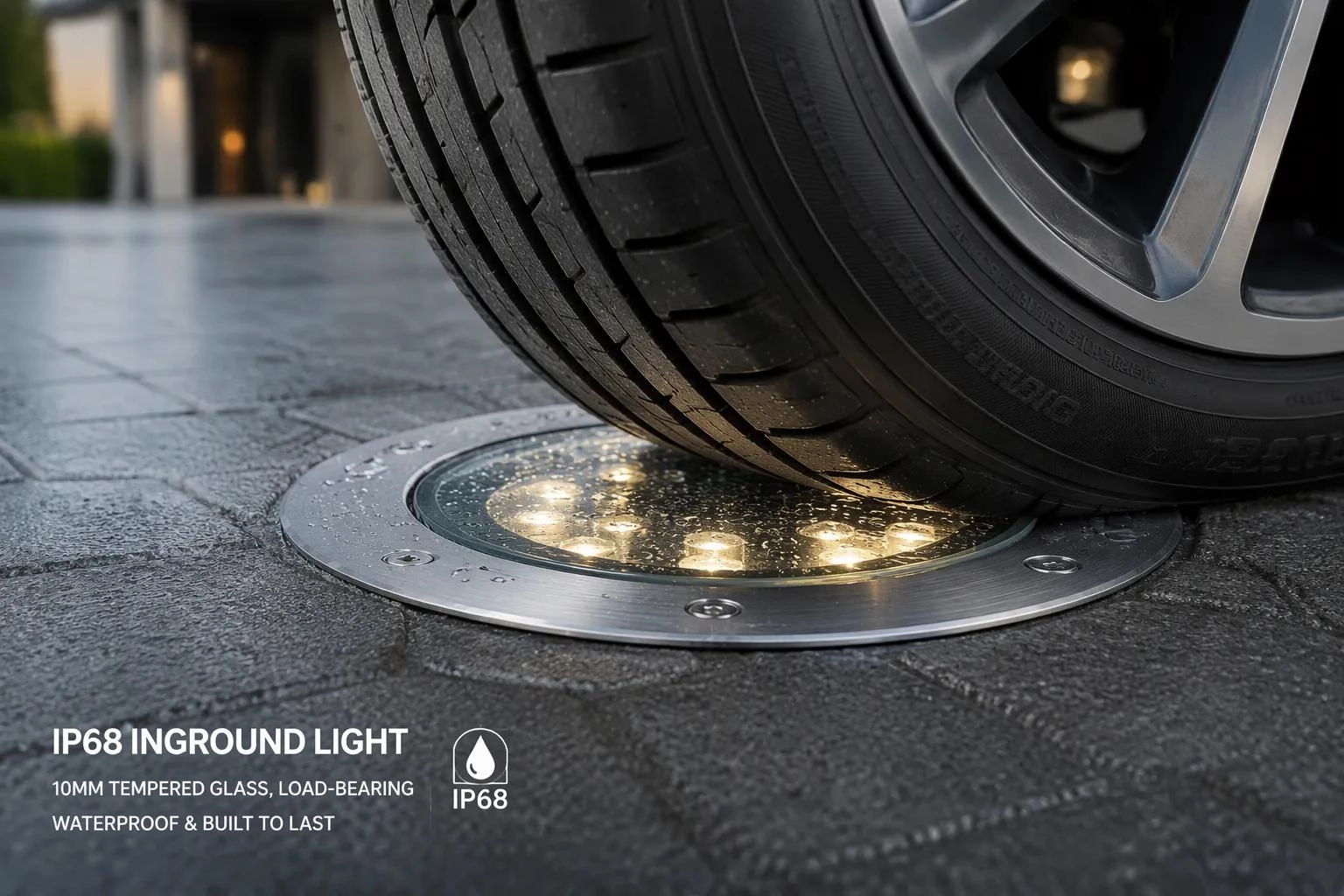
Load-resistant inground LED lights must withstand both foot and vehicle traffic to stay durable in plazas and driveways. Durability and load-bearing performance start with the housing, the lens, and the seal. A fixture that flexes under a tire will eventually crack its glass or admit water. Buyers should treat load ratings as engineering claims, not marketing labels. Housing material, wall thickness, and gasket design determine how a fixture behaves after years of rolling contact.
Manufacturers publish load ratings that separate standard fixtures from heavy-duty models. The IPHD LED inground light manufacturer lists a standard capacity of 5 tons and a heavy-duty capacity of 20 tons, or 200 kN, for die-cast aluminum or 316 stainless steel housings. Heavy-duty models also raise the waterproof rating from IP67 to IP68 and the impact rating from IK08 to IK10. Glass thickness grows from 6 mm to 10 mm, and rated lifespan extends from 30,000 hours to 50,000 hours. These paired upgrades matter: a stronger housing without a stronger lens still fails under impact.
Specification | Standard | Heavy-Duty |
Load capacity | 5 tons | 20 tons / 200 kN |
Waterproof rating | IP67 | IP68 |
Impact rating | IK08 | IK10 |
Glass thickness | 6 mm | 10 mm |
Lifespan | 30,000 h | 50,000 h |
A static load rating alone does not prove a fixture survives traffic. Shinyrock Lighting reports that engineering-grade floor washers pass a 2,000 kg vehicle rolling load test with no deformation or water leakage, a result suited to driveways and parking lots. That rolling test matters more than a parked-weight figure, because moving wheels concentrate stress on small contact points. A fixture rated for a stationary load may still fail when a wheel rolls across its edge.
Hipolighting warns buyers against choosing an arbitrary load value just because it appears common in the market. The company advises specifiers to define the expected traffic and demand evidence that the fixture and its installation suit that use. Hipolighting also notes that IK ratings classify impact resistance under test conditions and do not by themselves establish a safe vehicle load. Buyers should request both the rolling test report and the impact rating before approving a submittal.
Plaza and driveway demands differ in frequency and intensity. A pedestrian plaza carries foot or wheel loads from visitors and occasional maintenance vehicles. A commercial driveway carries repeated vehicle loads from cars and trucks every day. Hipolighting maps each setting to its own checks: pedestrian paths need surface durability and impact protection, pedestrian zones with service access need a declared load rating, and commercial parking areas need documented load performance and structural support.
Heavy-duty 20-ton fixtures suit vehicle-bearing driveways and parking areas, where repeated wheels test durability and corrosion resistance. Standard 5-ton led underground lights fit pedestrian zones and light-duty paths. Flexible linear runs in recessed channels serve long borders and transitions, while rigid round or square led underground lights serve focal points. Matching published load ratings to the traffic pattern protects both the lighting investment and the paving around it. Oversizing every fixture costs too much; undersizing a driveway costs again in rework.
Shape drives both layout and performance. Round and square led underground lights share the same housing materials and sealing standards, yet each shape serves a different design role. Round led underground lights soften a path edge and blend into curved paving patterns. Square led in-ground lights align with tile grids and straight borders, so the fixture disappears into the geometry of the plaza.
Buyers comparing round and square led underground lights should check the housing and lens first. A die-cast aluminum or 316 stainless steel body resists corrosion, and a toughened glass top cover protects the lens from impact. These round and square led underground lights also carry the load ratings covered earlier, so shape never replaces structural strength. Rigid linear led underground lights offer a third option for recessed ground installation. Their heavy-duty rigid structure and toughened glass top cover suit long, straight runs along a driveway edge or a building facade.
Aim matters as much as output. Adjustable led underground light models provide a ±25° tilt angle, which lets installers point the beam at a sign, a planter, or a facade detail without changing the housing position. This tilt range also helps when the paving slope differs from the target surface.
Beam angle sets the coverage footprint. A 15-degree beam concentrates light on a narrow feature, such as a column or a specimen tree. A 35-degree beam covers a mid-sized area and works well for general wayfinding. A 60-degree beam spreads light wide for wash effects across paving or low walls. Specifiers should match each led underground light to its task, then confirm the chosen angle and tilt against the site plan. Every led underground light in the layout should earn its place through a defined lighting job.
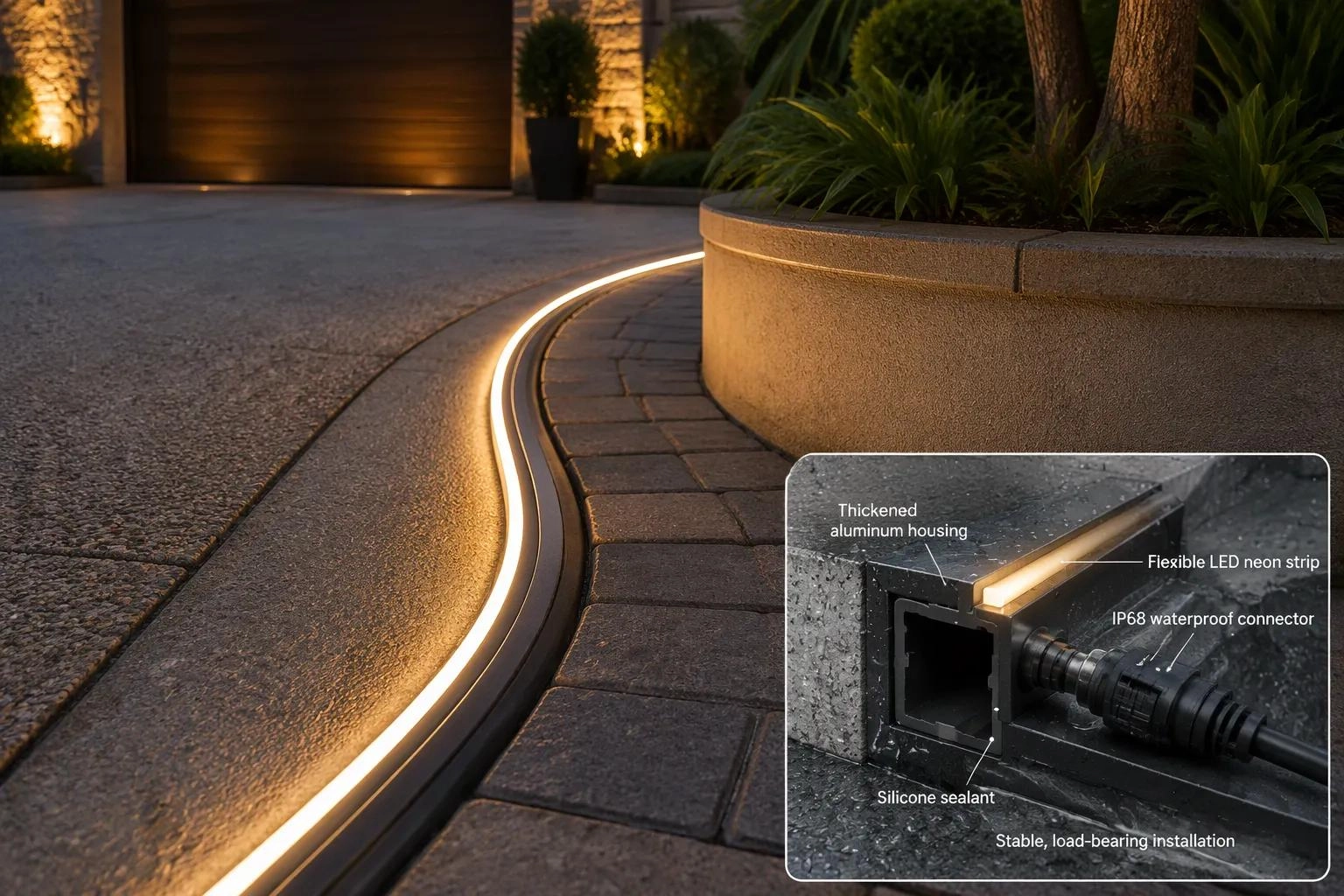
Flexible linear lighting solves the long, curved runs that rigid fixtures handle poorly. Underground led flex bends around planters, follows driveway edges, and lights transitions between paving materials. The product only performs when the seal and the channel suit the site. Buyers should treat sealing, channel construction, and fixture type as one decision, because a weak link in any of the three undermines the other two. A flexible run also needs a channel that carries the same load class as the paving around it.
Water is the main enemy of any buried fixture. The ip and ik ratings tell buyers how well a product resists dust, water, and impact. IEC 60529 defines the water digits. The IPX7 immersion test submerges a fixture in 1 meter of water for 30 minutes. The IPX8 test covers continuous submersion at a depth and time the manufacturer specifies. Cevonic notes that IP67 suits ground lights and temporary flood zones, while IP68 suits swimming pool lights and underwater equipment.
Drive-over underground led flex typically carries an IP67 rating with static loads up to 4,600 lbs. Fully sealed IP68 versions add continuous submersion protection for sunken plazas and poorly drained sites. Hipolighting reports that internal condensation is the biggest failure cause in underground lighting. The company adds that IP65 products are prone to moisture penetration in humid enclosed spaces, and it recommends IP66 with a breathable waterproof structure for underground engineering. Buyers comparing ip65–ip68 options should confirm the test depth and duration, not just the digits. A certificate that lists only the digits without the test method offers little assurance.
Impact protection matters equally. Heavy-duty led underground lights move from IK08 to IK10 as housings and glass thicken. The ik08–ik10 range separates pedestrian models from vehicle-bearing models. Specifiers should pair ip67 and ip68 ratings with the impact class the traffic demands. A high water rating cannot rescue a lens that cracks under a wheel.
Recessed walk-over channels hold flexible runs flush with the paving. A channel body anchors into the substrate, a diffuser sits at surface level, and the led underground light inside stays protected from wheels and feet. Walk-over floor channels suit long borders, step nosings, and curved paths where rigid fixtures cannot follow the geometry. Walk-over floor channels also simplify replacement, because crews lift the diffuser and swap the run without cutting paving. The channel profile should match the paving depth so the diffuser sits flush and the joint stays tight.
Rigid fixtures still win in some spots. A recessed walk-over channel adds a continuous joint line, while a single rigid fixture creates a clean focal point at a plaza center or driveway entrance. Flexible underground led flex serves linear continuity. Rigid led underground lights serve accents and short runs. Both approaches share the same durability requirements, and both depend on correct drainage and substrate preparation.
Buyers should request load-test reports and IP certificates for ip67–ip68-rated assemblies before approval. A walk-over installation fails quietly when the seal fails first, and the repair cost lands on the paving budget.
Drainage details belong in the specification, not in the contractor's improvisation. Syaled notes that a fixture with strong waterproof protection still requires proper drainage planning to achieve reliable long-term performance. Water collects around a housing when the base forms a sealed pocket. Crews should build an installation base that lets water move away from the fixture instead of trapping it.
Syaled lists several practical measures for commercial inground lighting installations:
· Place a drainage layer of gravel or another water-permeable material around the fixture.
· Use sealing rings, protected cable entries, and a strong housing structure.
· Include water outlet paths that guide collected moisture away from the fixture area.
· Position and protect cable entry points against water ingress.
· Keep fixtures out of low spots where water naturally gathers, unless added drainage measures exist.
Syaled also names the common failure causes: poor installation drainage, damaged seals, incorrect cable connections, and blocked drainage paths. Each cause traces back to planning. Burial depth follows the same logic. The housing must sit deep enough to clear the paving build-up and the channel profile, and the substrate below must stay stable under load. Specifiers should confirm depth against the fixture drawing and the paving section rather than a single universal figure.
Service access decides the real cost of ownership. A sealed fixture that fails deep in the paving forces crews to cut and rebuild the surface. Recessed walk-over channels solve this problem for linear runs, because the diffuser lifts out and the run slides free. Walk-over floor channels give the same benefit on straight borders and step edges. Rigid led underground lights need a serviceable route to the cable joint, so installers should leave a pull point or a removable paving unit near each fixture.
Walk-over installations also demand a maintenance plan. Crews should inspect seals, clear drainage paths, and check cable entries on a set schedule. A walk-over surface takes constant traffic, and small seal damage grows into a water problem fast. Documenting access points on the as-built drawing saves hours on every future service visit.
Compliance starts with the listing mark. The National Electrical Code requires light fixtures to be listed (NFPA 70, National Electrical Code, 2023 edition, §§110.3(A)–(C) and 410.6). A UL standard is a set of requirements, and UL certification shows that UL Solutions evaluated the product against those requirements. A seller's claim that a product "meets UL standards" or a lone test report does not prove a current listing. CE marking is the manufacturer's declaration of conformity with European rules, and it is not proof of the electrical safety certification a U.S. installation needs. FCC authorization covers radiofrequency requirements, and a connected fixture may need both FCC authorization and an electrical safety listing.
Buyers should read each mark for what it actually establishes.
Term or mark | What it establishes | What you still need to check |
UL Listed | UL Solutions evaluated samples against safety requirements, with periodic factory inspections. | Exact model, U.S. coverage, ratings, installation limits. |
ETL Listed | Intertek tested and certified the product to applicable standards, with follow-up inspections. | The same model and intended-use checks. |
UL Recognized Component | A part was evaluated for use inside another product. | Certification of the finished fixture. |
UL Classified | Evaluation covers specified properties or conditions of use. | Whether that evaluation covers your application. |
Suppliers can arrange DLC QPL listing, cULus, or UL testing on request, and DLC qualification can unlock utility rebates, per Beamfact. JCL lists UL/cUL/UKCA/FCC/CE/RoHS certification, IP65 protection, IK08 impact resistance, and an operating range from -40℃ to 55℃. Specifiers should also confirm that published load ratings and durability claims match the certified model.
Price tags hide the real cost. A cheaper fixture with a short warranty shifts replacement expense onto the owner. Buyers should compare warranty length, technical support, spare-part availability, and the labor cost of each replacement. A recessed channel that allows a quick swap saves far more over ten years than a small discount at purchase.
Replacement planning belongs in the budget. Crews should know which fixtures sit in high-traffic zones and stock spares for those positions. A fixture that fails under vehicle load can damage paving, and that repair dwarfs the fixture price. The lowest bid often loses on lifecycle cost once service visits and paving repairs enter the math.
Buyers can follow a clear sequence. First, confirm load requirements for the site. Next, select led underground lights and beam angles. Then specify underground led flex and its sealing class. After that, plan drainage and service access. Finally, check compliance and weigh lifecycle cost.
This sequence works as a practical checklist. Readers should request load-test reports and IP documentation before they approve any purchase. A fixture that suits one plaza may fail on busy driveways. Walk-over channels, walk-over floor channels, and walk-over diffusers each need the right load class. Match underground led flex and rigid fixtures to the actual site conditions, not the lowest price.
Please provide the following detailed information so that our business representatives can better understand your needs and get in touch with you as soon as possible.