
 EN
 English
 繁体中文
 Italian
 Greek
 Spanish
 Hebrew
 Japanese
 Portuguese
 Korean
 Russian
 French
 German
 Arabic
Blog & Events
Follow NOVANEON for more valuable information to know early
Follow NOVANEON for more valuable information to know early
Nov 03Source: Views: 4
An underwater IP68 flex neon LED strip is a continuous, bendable, fully sealed linear light built for permanent underwater use. LED chips mount on a flexible PCB. A silicone or neon-style diffusing housing surrounds the board, and a sealing method closes every cut end and connection point. The strip runs on 12V or 24V safety low voltage.
This pool lighting design guide covers the available options, profile selection, mounting methods, customization, and complementary products. Specifiers can use it to plan a complete layout with pool led strip lights that follow steps, benches, and wall lines. Each run stays seamless, so the finished water reads as one clean line.
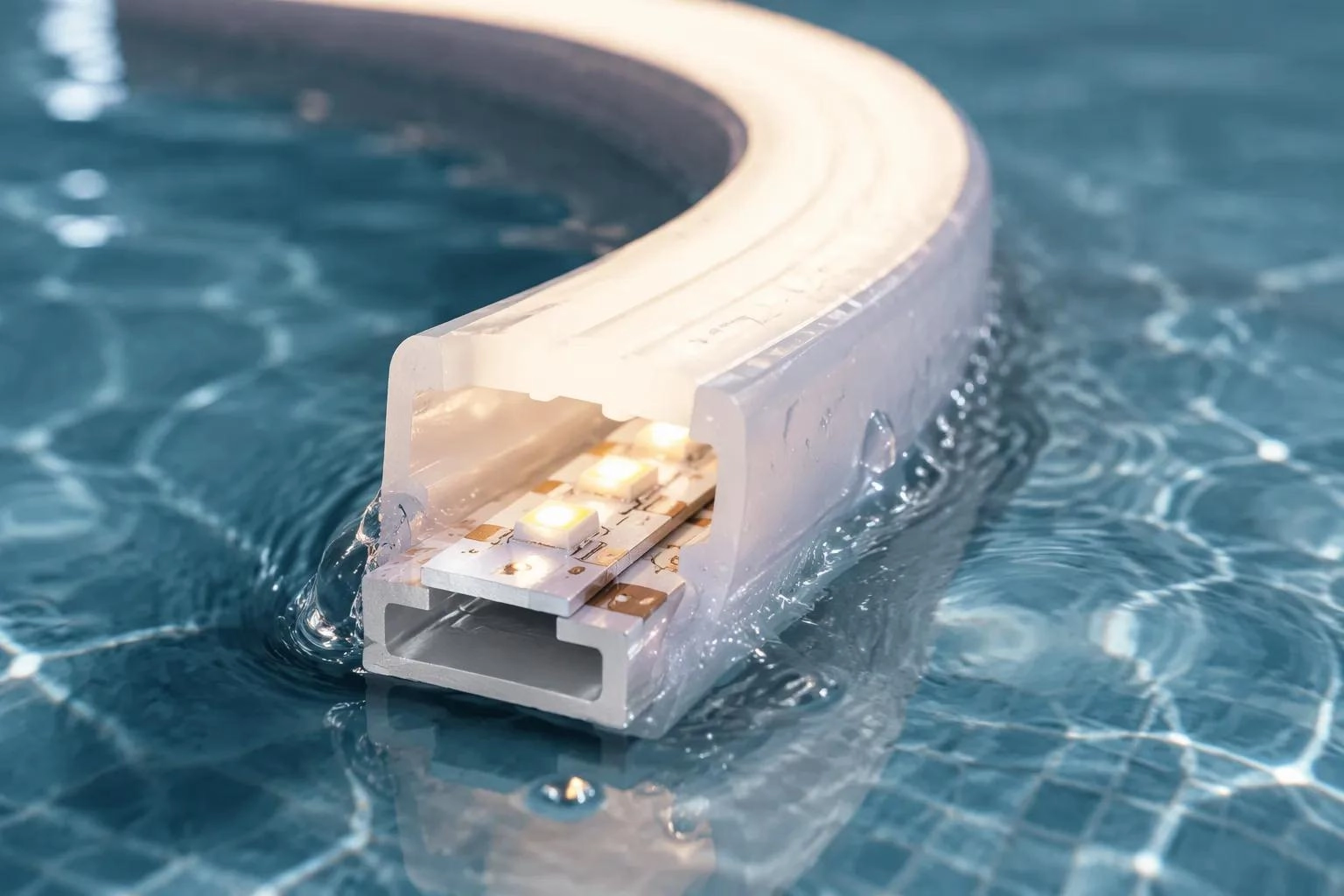
An IP68 flex neon LED strip is a continuous strip of waterproof led tape that bends around curves and stays sealed under water. The product combines LED chips, a flexible circuit board, and a diffusing housing into one linear light source. Planners specify these strips for underwater pool led strip lights because the sealed body tolerates permanent submersion without water ingress. The neon-style diffusing housing spreads light evenly along the run, so the strip reads as a smooth line rather than a row of dots.
The construction of led strip lights follows a clear component list. LED chips come from Cree, Citizen, Bridgelux, or San'an. The flexible PCB needs at least 2-3 ounce copper, and some builds use 4 ounce copper for better heat dissipation. A single-layer FPCB works but breaks easily during production, so the copper weight matters for reliability. Heavier copper also supports more stable output along long runs. The housing uses Dow Corning silicone, BASF TPU, Dow gas-phase silica gel, or BASF aliphatic TPU. Each material contributes flexibility, clarity, and chemical resistance.
Component | Specification |
LED chips | Cree/Citizen/Bridgelux/San'an |
FPCB | At least 2-3 ounce copper; 4 ounce for heat dissipation |
Sealing method | Integrated co-extrusion: LED strip, PET plate, food-grade silicone bonded in one tri-color high-temperature extrusion |
Housing materials | Dow Corning silicone, BASF TPU, Dow gas-phase silica gel, BASF aliphatic TPU |
Waterproof rating | IP67/68 submersible |
The integrated co-extrusion process bonds the LED strip, a PET twisting-proof plate, and a food-grade silicone housing into one solid piece. This tri-color high-temperature extrusion creates a 100% airtight seal. Silicone encapsulation resists UV, chlorine, and saltwater, and it stays flexible down to −40°C, according to Lightstec. Silicone also delivers a translucent glow and lasts 50,000+ hours underwater. The seal must survive thermal cycling, chemical exposure, and cleaning stress. PVC coating yellows and hardens under UV and chlorine, and water seeps through micro-cracks, so PVC suits IP65/IP67 outdoor use only and never permanent submersion.
Voltage choice shapes the layout. These low-voltage strips run on 12V or 24V DC. A 12V DC system is the safest option for residential pools, but voltage drop limits runs to about 5 meters, so installers use multiple shorter runs with separate power supplies. A 24V DC system supports longer runs up to 10 meters and higher-density strips, and it suits commercial pools and larger installations. Always use a certified low-voltage LED driver, not a regular AC adapter, and install the driver outside the pool enclosure in a dry, accessible location. Specifiers should confirm the driver location during design, because a wet or inaccessible driver becomes a maintenance problem.
Waterproofing depends on correct end treatment. Installers cut the strip and re-seal the new end with an end cap and silicone. They join sections with ip68-rated connectors that seat an O-ring, and they fill end caps with neutral-cure silicone. These steps preserve the seal and keep the waterproofing intact. A failed seal at a cut end is the most common cause of water damage in pool led strip lights, so every termination deserves inspection before the pool fills. The ip ratings table from Superlightingled confirms that these strips use a filled tube, serve wet areas and pools, and require re-sealing after every cut.
Waterproofing starts with the rating. Led strip lights for pools must carry that rating. Permanent submersion sets the bar for pool lighting. IP68 is the highest liquid protection rating, and it covers continuous immersion to the depth the manufacturer specifies, typically between 1 and 3 meters, according to FactorLED. The ip ratings scale separates IP65, which only resists water jets, from IP68, which handles hydrostatic pressure. FactorLED notes that IP67 suits the pool surround at most, and IP68 is the recommended minimum for any permanent underwater installation.
Seal construction separates durable pool-safe led strips from short-lived ones. Gasket-sealed fixtures depend on rubber O-rings, and chlorine, bromine, and UV exposure harden those seals over time. Finnforst reports that once a gasket cracks, water floods the housing and destroys the electronics. Factory-sealed, resin-filled IP68 designs encapsulate the board in solid epoxy, so gasket failure becomes irrelevant. Proper waterproofing also covers every cut end and connector, because a failed termination is the usual entry point for water. That layered waterproofing keeps led pool strips reliable across seasons.
Even output matters as much as durability in swimming pool lighting. Led strip lights with a neon-style diffusing housing spread light along the run, so pool led strip lights read as one continuous line instead of a row of bright dots. Designers use that smooth line to outline steps, trace benches, and mark entry points without glare. Consistent color temperature along the run keeps the water tone uniform.
Flexibility lets pool led strip lights follow curved walls, radius corners, and freeform edges. Pool-grade led strips bend in horizontal or vertical planes depending on the bending type, and that freedom supports custom linear designs. Led strip lights pair well with dimmable drivers and color control, which shift the mood from task light to ambient glow. A thoughtful design matches the bending type to a suitable controller for pool lighting.
Continuous linear LED flex comes in several cross-section sizes, and each size suits a different pool detail. Slim profiles fit tight step nosings and narrow seat lips. Wider profiles carry more light and work well for long wall lines and perimeter runs. The cross-section also sets the minimum bending radius, so size selection and curve planning happen together.
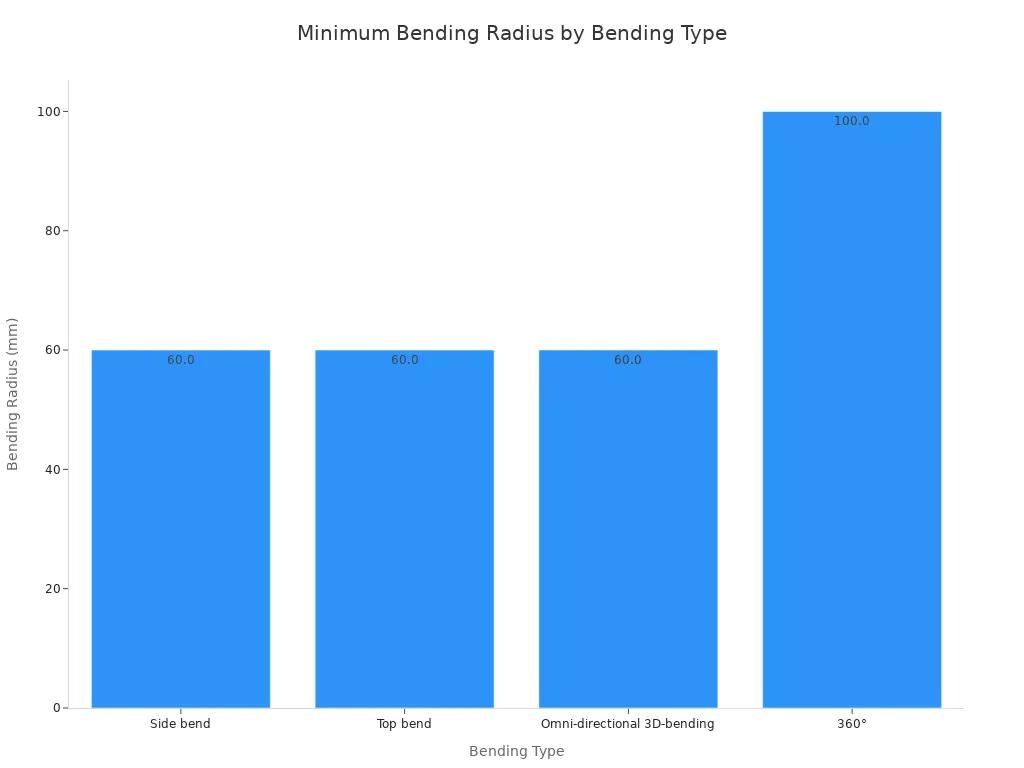
Suntechlite publishes a bending radius guide that pairs each model with its size and radius. The table below summarizes those figures.
Model | Bending Type | Size | Bending Radius |
S0410 | Side bend | 4*10X5000mm | R>30mm |
S0612 | Side bend | 6*12X5000mm | R>30mm |
S1220 | Side bend | 12*20X5000mm | R>60mm |
T1313 | Top bend | 13*13X5000mm | R>60mm |
3D1616 | Omni-directional 3D-bending | 16*16X5000mm | R>60mm |
Ø40 | 360° | Ø40X5000mm | R>100mm |
SignliteLED lists a 240 mm minimum bending diameter for its C22 and C25 round examples, while several top-bend and side-bend examples use a 100 mm minimum bending diameter. Buyers should verify the exact value for the selected profile before installation.
Side bend fixtures bend left to right along the horizontal plane, according to Suntechlite. Light emits from the top surface while the flexible movement happens on the sides. This type follows the inside face of a curved pool wall and traces freeform edges.
Top bend fixtures bend up and down along the vertical plane. Light emits from the same surface that curves, which lets the strip follow arching structures such as a raised wall cap. A 360° round neon flex emits light evenly from all directions and creates a smooth, dot-free glow with no visible dark sides.
Continuous linear LED flex can follow pool shapes, outline steps, and wrap around corners for custom linear designs. Flexible cutting belongs to the ordering and installation guide: installers cut only at marked intervals, then re-seal each new end. That step keeps every pool led strip lights run sealed and lets one order cover several measured segments.
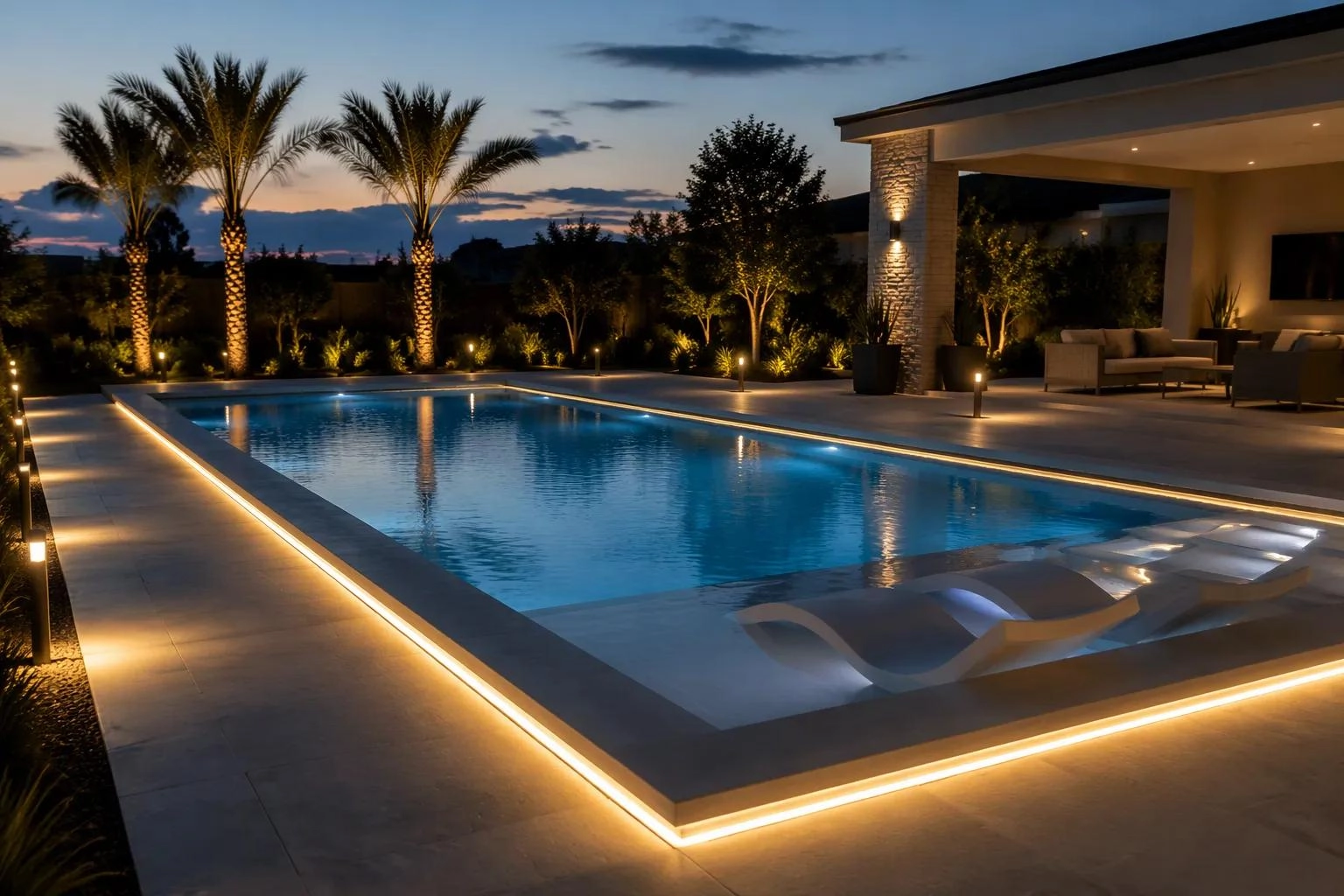
This section works as the practical pool lighting design guide. It moves from step lights and entry-to-seating runs through pool areas, outdoor kitchens, and entertainment spaces. Task-specific design considerations carry each project from initial design to final testing.
Placement decides whether a pool feels safe and inviting at night. Guy Robert Landscape notes that underwater lighting ensures visibility and establishes the primary glow. Fixtures should reveal steps, benches, and gentle ripples while avoiding harsh beams aimed toward the house or seating. A few well-aimed lights beat an excess of small sources.
· Step lighting marks risers and tanning ledges. Jim Hinson Pools calls recessed step lights a non-negotiable safety element, because steps visible by day can disappear at night. Low-profile niche-mounted units create a clear delineation without a harsh point of light.
· Under-coping runs sit concealed beneath the coping and direct light downward. The waterline glows softly, and the pool appears to float, separated from the deck by a ribbon of light.
· Deck, stair, and path fixtures call for soft, shielded output. Recessed step lights or undercap LEDs create low ribbons along walking areas, and fixtures stay below eye level and evenly spaced.
· Continuous lines along coping or risers define edges and elevation changes. Recessed tread lights mark steps discreetly without lighting the whole deck.
· Railing posts benefit from small downlights that improve safety and add definition.
Flexible LED strips along steps, benches, tanning ledges, and the waterline create a glowing outline at dusk. That effect helps clients picture the finished result early.
Profile selection follows the surface. Recessed channels suit step risers and tanning ledges, where the fixture must sit flush and resist kicking. Surface-mounted profiles work along walls and benches. Under-coping profiles hide the strip and throw light downward onto the water.
Mounting methods must protect the seal. Clips and channels hold the strip without pinching the silicone body. Installers keep every connection above the waterline where possible, and they seal cut ends before the pool fills. A failed termination is the usual entry point for water, so waterproofing checks belong on the punch list.
The workflow runs in order. Designers define the space, choose the size and bending type, select profiles and mounting, then pair the run with a suitable controller. Final testing confirms even output, sealed joints, and correct driver placement before handover.
Continuous linear lighting changes how a pool reads at night. Traditional led pool lights sit in niches and throw a single beam across the water. A sealed flex strip instead draws one unbroken line along steps, benches, and walls. That line removes hot spots and glare, and it lets the water surface carry the glow rather than a visible fixture. Designers gain freedom with complex shapes, because the strip bends around radius corners and freeform edges that rigid fixtures cannot follow. Installers gain speed, since one run replaces several separate units and their junction boxes.
Material choices protect the investment. Chlorine-resistant silicone keeps the housing clear and flexible through seasons of chemical exposure. The 24V safety low voltage simplifies wiring and reduces risk in wet locations. A 5-year warranty applies where the manufacturer offers it, and that coverage gives specifiers confidence when they compare options. Hayward notes that modern pool lighting systems now offer dimming, speed adjustment, and additional colors, so a linear run can match the same control expectations.
NOVANEON supplies these strips and also builds indoor linear fixtures for the spaces around the pool. The PV1516L-DALINE 10 is a reliable LED rigid light bar for architectural and display work. It uses DALINE-10 lens optics with WAS, WW, O, W, and M beam angles, CRI 90, and color temperatures of 2700K, 3000K, 4000K, and 6500K. The standard length is 285mm, with 565mm, 845mm, and 1125mm options. Each unit draws 10W maximum and reaches up to 77lm/W at 4000K Ra90. It operates from -40°C to +55°C, carries an IP20 rating, and ships with steel clips. Driver options include 24VDC and 30-38VDC.
This bar suits cabinet, shelf, cove, handrail, and architectural lighting rather than underwater use. Pair it with pool led strip lights for a unified look between the pool deck and the cabana interior. Customization extends to color shows and dimming, and Hayward describes detachable cords that ease installation and service. Designers can plan led strip lights for the water and led pool strips for the surround, then finish with led pool lights only where a niche fixture is required.
A controller only works when every part of the system agrees. Mekong Lighting lists four matching factors: strip voltage, output channels, power and load, and output type. Constant current drivers suit runs up to 30 meters, while constant voltage suits runs up to 5 meters, according to LNLED. Installers should confirm voltage, channel count, signal protocol, and controller capacity before ordering, as Shiji LEDs advises. They should also test scenes before the pool fills.
Attribute | Options |
IP grades | IP65, IP67, IP68 |
Connectors | IP65/IP67/IP68 waterproof connectors |
CC/CV | Constant current 30 meters; constant voltage 5 meters |
Power consumption | Customized power available |
Waterproofing and safety depend on the full chain. Shiji LEDs notes that protection must cover connectors, end caps, cable entries, mounting accessories, and exposed control components. Two ip68-rated connectors join strip sections, and a sealed enclosure houses the controller. Installers keep control gear in a dry, accessible spot outside the pool enclosure.
Dimming and color control turn a static line into a flexible tool for pool lighting. A continuous rgb+w led strip supports white output plus mixed color, and addressable versions add chasing effects. A led color-changing pool light retrofit lets owners upgrade an existing niche fixture to the same control scheme. Designers can plan scenes for evening swims, parties, and quiet nights.
Creative effects belong to the wider lighting design. Color-changing architectural systems extend the same logic to cabanas and outdoor kitchens. Shiji LEDs groups static white, dimming, RGB, RGBW, and addressable effects as separate control categories, each with its own wiring logic. Matching the controller to the strip type keeps pool led strip lights predictable. Installers should treat led strip lights as one system from strip to controller to power supply to wiring. That discipline protects every led strip lights run, and it keeps the design consistent across the deck and the water.
A pool lighting design guide follows a clear order. Designers define the space first, then choose the right size and bending type. Next they select profiles and mounting methods, and finally they pair each run with a suitable controller. This workflow keeps every pool lighting decision connected from plan to final test.
Continuous, seamless output gives the pool a clean look that niche fixtures cannot match. Before ordering, buyers should confirm the ip68 rating, 24V low voltage, and chlorine-resistant silicone. Proper waterproofing at every cut end protects that investment. Readers can now plan their layout and consult the product specifications for their swimming pool lighting project.
Please provide the following detailed information so that our business representatives can better understand your needs and get in touch with you as soon as possible.