
 EN
 English
 繁体中文
 Italian
 Greek
 Spanish
 Hebrew
 Japanese
 Portuguese
 Korean
 Russian
 French
 German
 Arabic
Blog & Events
Follow NOVANEON for more valuable information to know early
Follow NOVANEON for more valuable information to know early
Nov 03Source: Views: 1
Underwater LED lights in chlorine, saltwater, and chemically treated water usually fail for two reasons: material degradation and seal failure. The LED chip itself rarely burns out first. Three chemical stressors drive this decline — chlorine, salt, and water-treatment chemicals. Each one attacks housings, seals, and connectors from the outside in. Electrical stress and chemical incompatibility are the two forces that shorten LED lifespan most often. A fixture may keep glowing while its shell quietly weakens. Pool lights exposed to chlorine, saltwater, and chemicals face this combination daily. Understanding why failures happen helps owners judge what actually protects an underwater luminaire.
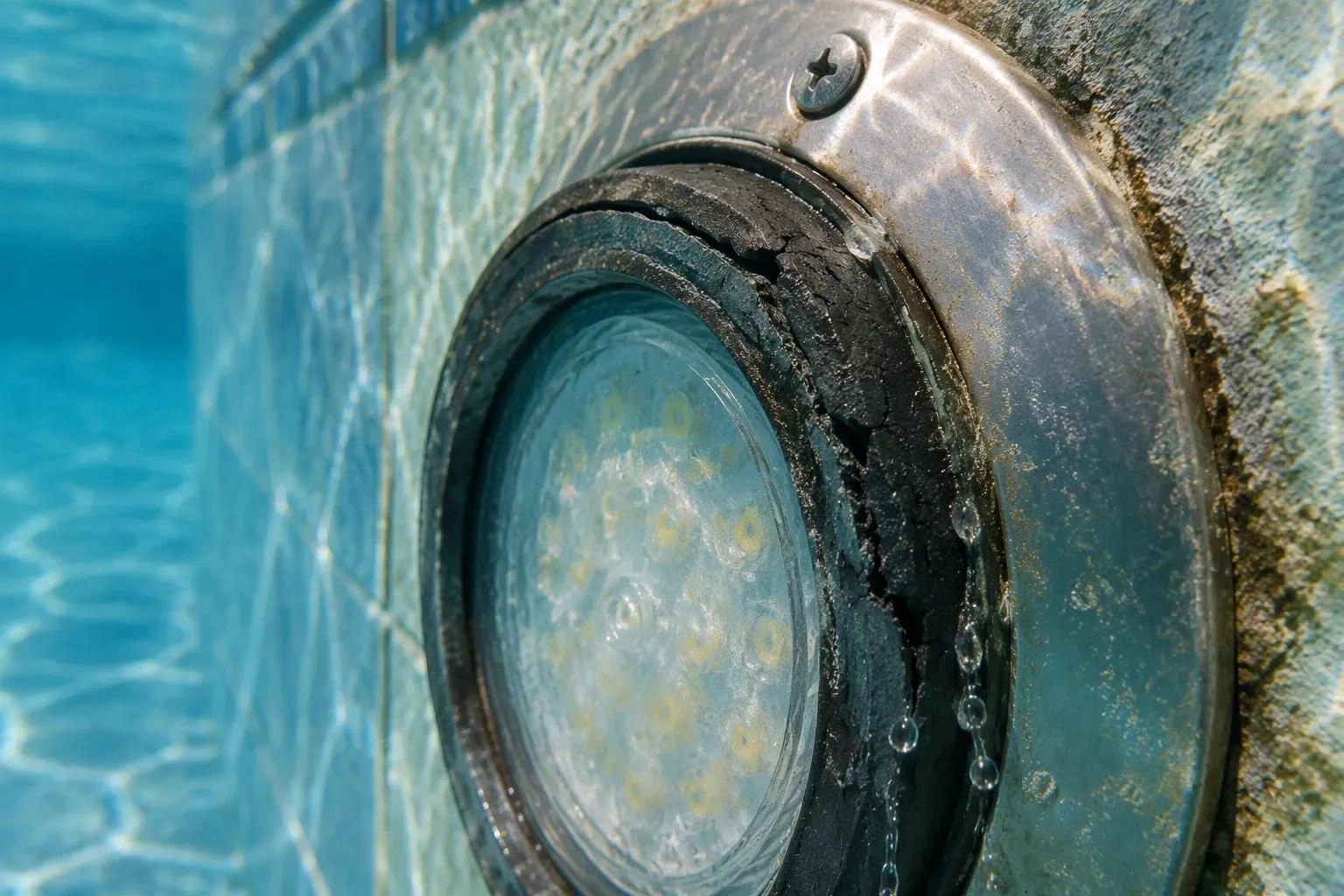
A high IP rating tells a buyer that a fixture resists water entry under test conditions. It does not tell the buyer that the fixture resists chlorine saltwater and chemicals over years of service. The rating measures a test result, not a service life. Volatile chemicals can penetrate the interior of an underwater luminaire even when the unit carries a strong ingress rating. The pathway is rarely a dramatic breach. Small amounts of chemistry migrate through seals, gaskets, and cable entries, and they accumulate inside the housing. Pool lights face this chemistry every day.
Pool lights with gasket seals depend on rubber O-rings. Sanitizers, bromine, and UV exposure degrade these rubber seals over time, according to Finn Forst. Once a gasket hardens and cracks, water enters the housing and destroys the internal electronics. A resin-filled IP68 pool light encapsulates the LED board in a solid epoxy compound, and that design makes gasket failure far less consequential.
Installation quality decides how long any seal lasts. Willele notes that even the highest-rated enclosure will fail when cable glands sit loose, when installers use incompatible cables, or when gasket surfaces suffer damage during installation. Several field conditions accelerate the decline:
· Extremely high disinfectant levels, pH imbalances, or excessive mineral content speed the degradation of seals and housing materials.
· UV exposure degrades heat shrink tubing over time, particularly in shallow water with significant sun exposure.
· Saltwater pools demand enhanced resistance throughout the assembly.
· Gaskets and seals typically need replacement every 3-5 years.
These failure modes produce familiar symptoms. A homeowner may notice water behind the lens, gasket leaks, or a light circuit GFCI tripping. Each symptom points to a breach that started long before the visible failure. By the time water has seeped into the lamp housing, the damage usually extends beyond the seal itself.
Corrosive pool chemistry attacks the fixture body and the screws that hold a light together. Happiness Light describes how corrosion creeps in slowly during a pool light changeout, especially in older shells. A gunite pool adds its own pressure: the porous surface traps moisture, raises mineral interaction, and aggressive water chemistry speeds the process. Replacement often follows.
Saltwater raises the stakes. At salt concentrations of 2,700 to 3,400 ppm typical of residential saltwater pools, the water attacks aluminum housings, uncoated brass, standard 304 stainless steel, and conventional neoprene gaskets, according to Fort Lauderdale Pool Lights. Marine-grade 316L stainless steel and titanium resist saltwater corrosion far better. Lutou Tech reports that powder-coated aluminum fails within 3 to 5 years in typical outdoor settings, and that grade 304 stainless steel pits when exposed to salt air. Pool lights often corrode from the inside out, and an LED fixture rarely survives a breached housing.
Electrical stress and chemical incompatibility remain the two main drivers of shortened LED lifespan. Water and chemical exposure weaken electrical and metal components from the outside in. Saltwater corrosion of circuits follows once moisture reaches the board. Chlorine saltwater and chemicals shorten service life through the same routes. The lesson is simple: water and electricity coexist safely only when the housing, seals, and metals all match the water chemistry.
A saltwater pool generates its own sanitizer instead of storing it in a jug. Carlton Pools explains that water passes over titanium plates coated with ruthenium or iridium, and a low-voltage current splits the salt through electrolysis. The Pool Nerd notes the cell produces sodium hypochlorite, the same active chlorine sold in liquid form, plus sodium hydroxide with a pH around 13. The water feels softer, yet it still carries salt and chlorine exposure. Salt acts as an electrolyte and accelerates galvanic corrosion. The Pool Nerd lists light niches and screws among the parts worth periodic inspection. Saltwater pools therefore demand saltwater-resistant pool lights, not fixtures designed for fresh water alone.
Corrosion problems commonly appear when owners swap pool lights for plastic LED or nicheless LED models in saltwater pools. Aqua Leisure Pools and Spas offers a direct warning:
If you run a salt water chlorine generator, always choose a light with a plastic face ring rather than stainless steel. Salt water can accelerate galvanic corrosion on metal rings, whereas high-impact plastic remains completely unaffected.
Upgraded led pool lights still face a punishing set of conditions. A study in PMC reports that salt ions penetrate encapsulation and start electrochemical corrosion, while hydrostatic pressure rises about 1 atm per 10 m and can deform seals. Underwater temperatures stay fairly stable between 5 and 30 °C, so thermal stress matters less than chemistry. The table below summarizes these demands.
Factor | Effect on fixtures |
Salt water | Ionic penetration drives corrosion |
Chemicals | Moisture uptake degrades encapsulation |
Impact | Waves and debris stress housings |
Temperature | Stable range limits thermal stress |
Fixtures built for high-salinity and highly corrosive environments suit saltwater pools and coastal installations. The corrosive nature of saltwater and the corrosive effects of saltwater make material choice decisive for underwater lighting. Buyers who understand chlorine saltwater and chemicals can judge which led fixtures survive long term.
Only IP68 fixtures belong underwater. The second digit describes protection against water entry, and a rating of 8 means the housing resists continuous submersion beyond 1 m under conditions the manufacturer specifies, according to Suntech Lite. Suntech LEDs adds that a rating of 8 allows submersion at a certain pressure for an unlimited time while the fixture still works normally.
Rating | Meaning |
8 | Protected against continuous submersion beyond 1 m, conditions specified by manufacturer |
That certification covers one sample, one depth, and one duration. Suntech Lite advises buyers to ask two follow-up questions: what depth and duration the test used, and which chemicals and temperatures the encapsulant faced during aging tests. A strip tested only in fresh tap water may fail early in a spa or a saltwater fountain. The same caution applies to pool lights sold for permanent installation.
A high rating addresses water ingress. It does not stop chemical penetration over time. LNLED notes that users often confuse water-resistant with chemical-resistant, and that most standard waterproof strips resist water entry but are not built to withstand pool chemicals or harsh cleaning agents. The casing material must stay intact for the rating to mean anything.
Hydget Lighting describes how chemistry defeats a mechanical seal in coastal settings. Marine salt fog leaves deposits along housing seam edges and triggers localized galvanic corrosion on unprotected metal surfaces. Oxide growth along gasket channels then disrupts smooth sealing faces and opens micro-gaps that let moisture pass under storm pressure. Solid silicone extrusions avoid this path by eliminating exposed metal joints and mechanical gaskets, so the protective matrix surrounds the circuit directly. Buyers of underwater lights should treat the IP number as a starting point and confirm the housing material and seal design against their own water chemistry.
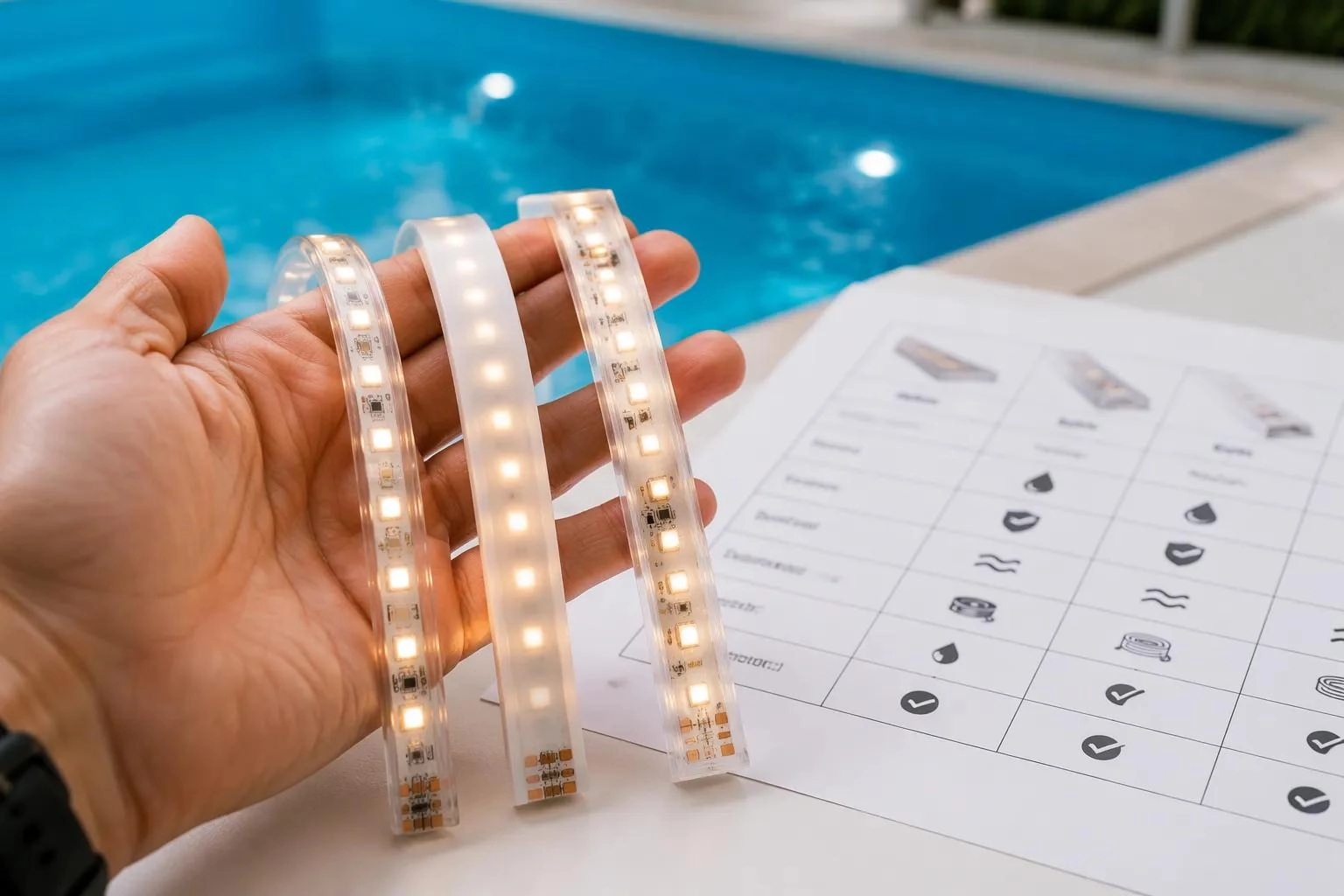
The outer layer of a fixture decides how long the circuit inside survives. A PVC outer layer reacts badly with pool chlorine. It turns yellow, hardens, and cracks over long use. Once the shell cracks, water reaches the circuit directly. Suntech Lite reports that PVC turns yellow and cracks quickly in pool water and suits only temporary decorative lighting. Silicone or PU coatings perform better in chlorine and saltwater than cheaper PVC types. Ledyi Lighting notes that high-quality strips with PU or silicone coatings and proper sealing are safe for saltwater environments, while cheaper PVC-coated strips break down faster.
Each material has a best-fit role. The table below compares the four options on the properties that matter most.
Property | Silicone | PVC | Epoxy / PU |
Water resistance | Good, delamination risk | Basic protection only | Good for static use |
UV resistance | Good, slow yellowing | Poor, fast aging | Moderate, yellowing risk |
Temperature range | -40°C to +150°C | -20°C to +60°C | -40°C to +120°C |
Flexibility | Excellent | Moderate | Poor after curing |
Chemical / chlorine resistance | Moderate, gradual erosion | Poor in chlorinated water | Good chemical resistance |
Typical cost | Medium | Low | Medium |
Silicone neon flex earns a strong recommendation for critical work. DFLED Lighting states that silicone neon flex is the preferred choice for critical underwater applications because of its long-term reliability, consistent light diffusion, and resistance to chlorine, saltwater, and pool chemicals. Epoxy suits fixed, straight runs. It reaches full submersion but turns brittle over time and cracks when bent. TPU holds flexibility in cold conditions, with Huayoung LED rating it flexible down to -40°C.
Water chemistry sets the matching rule. LEDFlex Linear rates BASF aliphatic TPU for IP68 submersible use in pools and fountains, with zero hydrolysis and chlorine resistance. Fumed silicone serves extreme marine environments and stays optically pure for over seven years, according to LEDFlex Linear. PU fits dry indoor areas and light splash zones. Standard PVC fits no demanding pool role in that same LEDFlex Linear assessment.
Saltwater pools raise the bar further. Salt ions drive corrosion at metal joints, so a waterproof and anti-corrosion structure matters as much as the coating. Buyers choosing saltwater-resistant pool lights should confirm the housing metal, the seal design, and the jacket material together. The same logic applies to led pool lights in fountains and coastal features. A sound material match keeps underwater pool lights serviceable for years. Owners of pool lights in saltwater pools should also inspect connectors at each season. That habit protects any led fixture, whatever coating it carries. Material choice, not the led chip, decides the outcome.
The connector is often the first point of failure on an underwater fixture. A sealed termination keeps water away from the conductor joint. Cableharnessassembly.com lists four common sealing methods: O-rings, overmolding, potting, and heat shrink. Overmolded terminations deserve attention. Custom-tooled overmolds in PUR, TPE, or silicone bond directly to the cable jacket, and this bond eliminates mechanical sealing joints. A mechanical joint relies on compression, and compression loosens with age. A bonded overmold has no gap to loosen.
Adhesive-lined heat shrink adds a second layer of defense. Dual-wall heat shrink carries a hot-melt adhesive inner layer, and that layer creates a watertight seal over splices, transitions, and breakouts. One marine case study overmolded each connector transition in PUR and sealed all branch points with adhesive-lined heat shrink. The assembly passed an immersion test at 3 m for 48 hours. Proper wiring, grounding fixation and waterproof sealing belong together in any installation plan, and each one supports the others.
The jacket material decides how long the cable survives chemical exposure. Cableharnessassembly.com recommends PUR, TPE, silicone, XLPE, and LSZH jackets for waterproof harnesses. Silicone and XLPE offer the best long-term water resistance for continuous submersion. Silicone also holds a temperature range of -40°C to +200°C. For outdoor UV exposure, PUR or UV-stabilized TPE jackets resist degradation for 3,000+ hours under accelerated UV testing. Marine harnesses pair tinned copper conductors with LSZH jackets, and the same source reports 3,000+ hours of salt spray resistance.
Application | Recommended jacket |
Continuous submersion | Silicone, XLPE |
Outdoor UV exposure | PUR, UV-stabilized TPE |
Marine | LSZH with tinned copper |
Chlorine (pool/spa) | Chlorine-resistant insulation |
Strain relief protects the jacket at the entry point. A cable that flexes against a sharp gland edge wears through its jacket, and water then reaches the conductors. Pool lights in saltwater settings face constant movement from water flow and cleaning. Corrosion of electrical and metal components follows once moisture enters a worn jacket. Buyers should confirm that each led fixture ships with a rated gland and a flexible transition. These details support electrical safety standards and extend service life in any saltwater pool.
Long-term survival in chlorine saltwater and chemicals rests on material selection and structural design. The led chip rarely decides the outcome. Usage frequency, water chemistry, installation quality, and regular maintenance all shape service life. Owners should match seal design, housing material, IP rating, and connector quality to their specific water environment.
A practical checklist helps guide the decision:
· Match the housing and jacket material to the water chemistry, especially in saltwater pools and coastal sites.
· Verify the submersion rating and confirm the test depth and duration.
· Inspect connectors, glands, and seals at each season.
These steps keep pool lights dependable in saltwater settings and extend the life of any pool lights installation.
Please provide the following detailed information so that our business representatives can better understand your needs and get in touch with you as soon as possible.