
 EN
 English
 繁体中文
 Italian
 Greek
 Spanish
 Hebrew
 Japanese
 Portuguese
 Korean
 Russian
 French
 German
 Arabic
Blog & Events
Follow NOVANEON for more valuable information to know early
Follow NOVANEON for more valuable information to know early
Oct 28Source: Views: 6
Asymmetric optics direct light toward a selected side or surface. Symmetric optics spread light evenly around the fixture. This distinction shapes every decision in architectural linear lighting. It governs where light lands, how much output is wasted, and whether a design meets glare and light-trespass expectations. The choice matters to architects and specifiers, because a misplaced beam pattern is hard to correct later. The comparison below weighs symmetrical vs. asymmetrical lighting on performance, application fit, compliance, and cost. It ends with practical specification guidance. Asymmetrical optics serve targeted surfaces well. Symmetrical optics serve open areas where even coverage matters. Each option has a legitimate role.
In architectural linear lighting, the optic choice shapes the whole layout. A luminaire sends light into a space according to its distribution, and the optical axis marks the centerline of that output. The axis is an imaginary line running straight out from the face of the fixture. Specifiers new to photometrics can treat these two terms as the entry point for every optics conversation. The symmetric versus asymmetrical distinction is fundamentally beam geometry, and photometric files describe it precisely. A polar plot shows the shape of that geometry, and the curve reveals which way the light travels. Neither term signals quality; both describe where the light goes.
An asymmetrical distribution intentionally directs more light toward a selected side or surface. The optics push output in one direction rather than spreading it evenly. This asymmetrical light distribution suits a wall, a facade, or a display that needs stronger illumination on one plane. Designers select an asymmetrical distribution when the target sits off to one side of the run. An asymmetrical distribution tilts the beam away from the axis, and that tilt defines the target. The distribution pattern then favors one side and limits light on the opposite side. A lighting fixture aimed at a specific direction of travel, such as a corridor edge, also benefits from this approach.
A symmetrical distribution spreads light evenly around the optical axis. The beam pattern looks the same on every axis, so light falls equally to the left and right of the run. This symmetrical output serves open areas where no single side deserves priority. A symmetrical distribution also simplifies layout work, because the output behaves predictably on all sides. The symmetrical distribution repeats around the axis, and manufacturers often describe it with a single curve. The result is a balanced pool of light with no obvious hot side. Both options belong in the architectural linear lighting toolkit, and each answers a different design question. A specifier who reads the geometry can match the optic to the task with confidence.
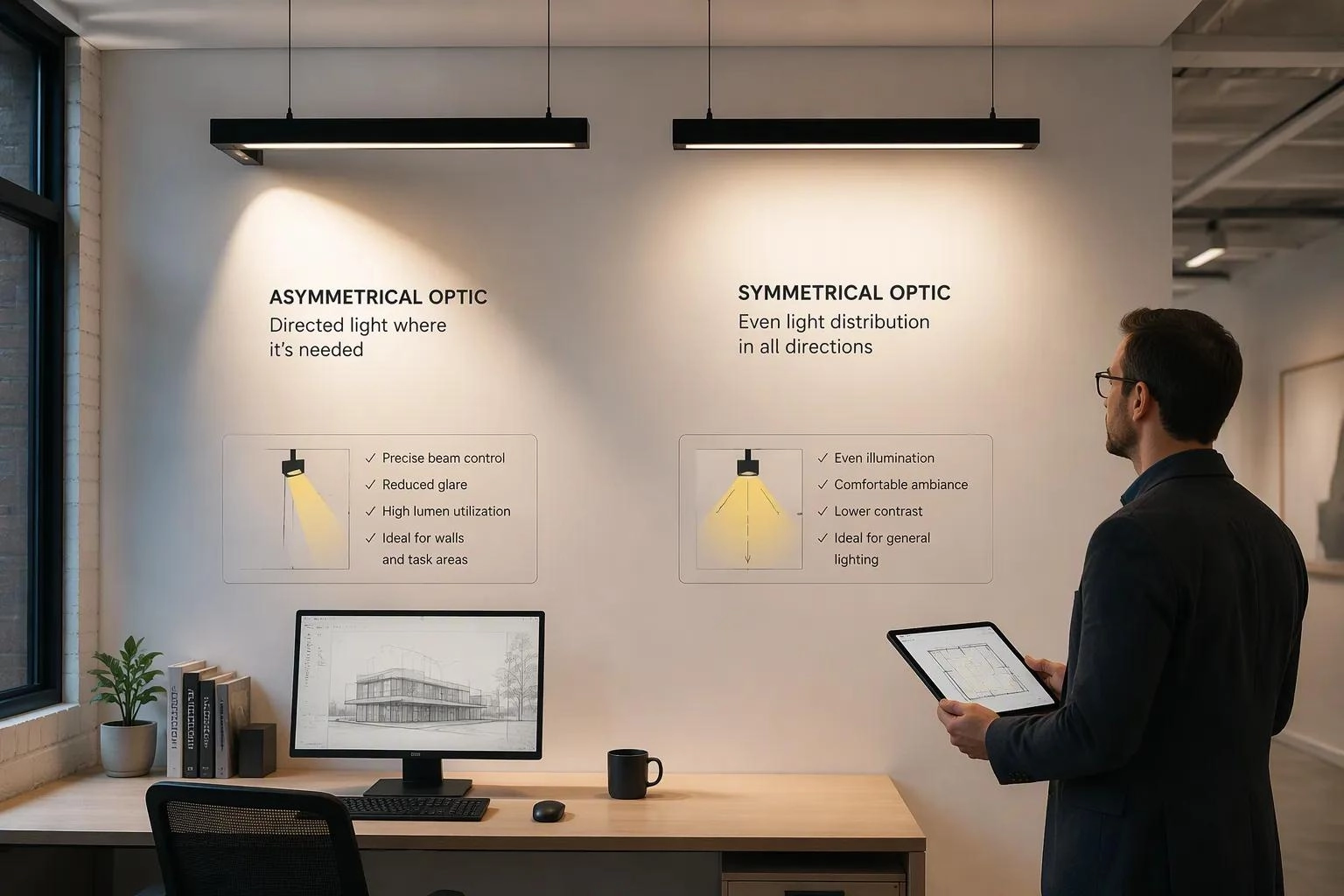
Performance separates the two optic families in ways that matter on the drawing board. Beam control, glare, and lumen utilization each behave differently, and no single option wins on every measure. A specifier who understands the trade-offs can match the optic to the job.
Beam control describes how tightly a luminaire holds its output to a target. Asymmetrical optics shape the light path with reflectors and lenses, so illumination lands on the task area and stays off the screen. This directional control minimizes screen reflections and direct glare, and it prevents direct eye exposure. The result supports comfortable viewing during prolonged screen use. Symmetrical distribution takes the opposite approach. It spreads light evenly in all directions for broad, even illumination. That even spread suits general desk activities, yet light reaching a screen can create reflections that reduce visibility. Light traveling toward the eyes may also raise discomfort. A symmetrical optic still earns its place: it reduces visual fatigue, supports focus, and delivers controlled, glare-free light suited to open-plan offices. One product line pairs that soft indirect illumination with a 52x98° beam angle, which the maker presents as ensuring controlled illumination and high visual comfort. The trade-off is clear. Asymmetrical optics buy precision at the cost of coverage. Symmetrical optics buy balance at the cost of directional control.
Lumen utilization measures how much output reaches the intended surface. An asymmetrical distribution sends more light where it is needed, so less output scatters into unwanted zones. That focus can raise useful illuminance on a wall or facade without adding fixtures. A symmetrical distribution spends output in every direction, which serves open floors well but can waste light near a boundary. Beam angle alone does not solve every case. Asymmetrical optics can outperform simply widening the beam when installation conditions are complex or facades are irregular. A wider beam spreads light further, yet it cannot steer output around an obstruction or follow a stepped elevation. A shaped asymmetrical distribution can. The trade-off runs both ways. A narrow asymmetrical beam pattern demands accurate aiming during commissioning, and a misaligned fixture shows its error plainly. A symmetrical beam forgives placement error and covers irregular layouts with less planning. Neither approach guarantees efficiency on its own. The specifier weighs target geometry against installation tolerance, then selects the distribution that keeps wasted light low in that specific setting.
Asymmetric optics shape vertical illumination with precision. A wall washer built around an asymmetrical distribution redirects more light upward along the wall, which produces smoother illumination and reduces spill. This approach suits facade and architectural lighting, including high-rise facades, narrow installation spaces, curved building surfaces, and continuous runs. Common asymmetric beam angles include 10°×60° and 15°×45°. Internal optical deflection paired with external honeycomb louvers or baffles can achieve zero light spillage. A minimum setback distance of 150 mm supports uniform grazing without line-of-sight glare. Asymmetric lensing also raises system efficacy, with output up to 125 lm/W, and it prevents luminous scalloping. A facade-mounted fixture aimed to wash a wall surface benefits most from this directional control. Narrow, defined beams and soft diffuse distributions still serve their own roles, and each complements the asymmetric option.
A symmetrical distribution fits open areas, pathways, and general illumination where even coverage matters. The output spreads equally on both sides of the run, so a corridor or plaza receives balanced light without a favored side. This distribution simplifies layout planning, because the pattern repeats predictably along the length. A symmetrical distribution also forgives minor aiming error, which helps on irregular sites. Specifiers should validate either choice through photometric simulation with IES files and DIALux, checking illuminance distribution, uniformity, fixture spacing, scalloping, and light spill. The asymmetrical distribution wins where a target surface sits off to one side. The symmetrical option wins where the floor itself is the target. Neither approach displaces the other, and the application decides the fit.
Directional control decides how much light escapes a property line. An asymmetrical distribution aims output at the target surface, so less output crosses the boundary toward neighbors or habitat. A symmetrical distribution sends light in every direction, which raises spill risk near a boundary. Codes respond to this difference through several levers. Uplight limits require fully shielded or full-cutoff luminaires and push specifiers toward precision optics and zero-uplight product families. Lumen limits cap total output per fixture or per site, which shifts competition from raw output to optical efficiency. Many jurisdictions set 3000 K as a common maximum color temperature, and some require 2700 K or lower. Curfews and adaptive controls reward dimming and occupancy sensing. Light-trespass rules set maximum illuminance at the property boundary, so photometric modeling and house-side shields become part of the design. Lighting zones LZ0 through LZ4 adjust allowable levels by ambient context. Better optics can hold site performance with fewer lumens, and documented BUG ratings and boundary illuminance support that claim.
Glare metrics give specifiers a numeric check on visual comfort. Unified Glare Rating and Glare Rating both fall when an optic concentrates light on the task. Symmetric optics can produce overlap or gaps that worsen glare control and uniformity. An adjustable asymmetric beam of 25–45° concentrates light on the surface, avoids wasteful spillage, and removes cross-shadows. Specifiers should confirm glare values in the installed orientation, because shielding alone does not guarantee compliance.
Optical complexity drives the purchase price of a linear luminaire. An asymmetrical fixture carries extra reflectors, lenses, or deflection surfaces, so its unit cost typically runs higher than a plain symmetric unit. A symmetrical fixture uses simpler optics, and that simplicity shows up on the quote. Buyers should compare the delivered cost of the whole run, not the price of one unit. A higher-cost optic may allow wider spacing, which trims the total count.
The comparison also depends on the beam angle. A narrow asymmetric optic concentrates output, and a wider symmetric optic spreads it. Neither approach costs less by default. Specifiers should request photometric files and compare layouts at equal illuminance before they judge value.
Installation effort differs between the two families. An asymmetrical fixture demands accurate aiming during commissioning, and a misaligned unit shows its error on the target surface. That precision takes time from the installing crew. A symmetrical fixture forgives minor placement error, so crews can set it faster on open layouts.
Complex sites may favor asymmetric optics over wider beam angles, and that choice affects total cost. A wider beam cannot steer output around an obstruction or follow a stepped elevation. A shaped distribution can, which may remove extra fixtures from the design. Fewer units lower material cost, wiring cost, and long-term maintenance visits. Lifecycle economics also include energy use. Better optical control can hold site performance with fewer lumens, and that saving compounds across the service life of the lighting system. Neither option wins on every project. The specifier should weigh aiming labor against fixture count and energy draw for the specific site.
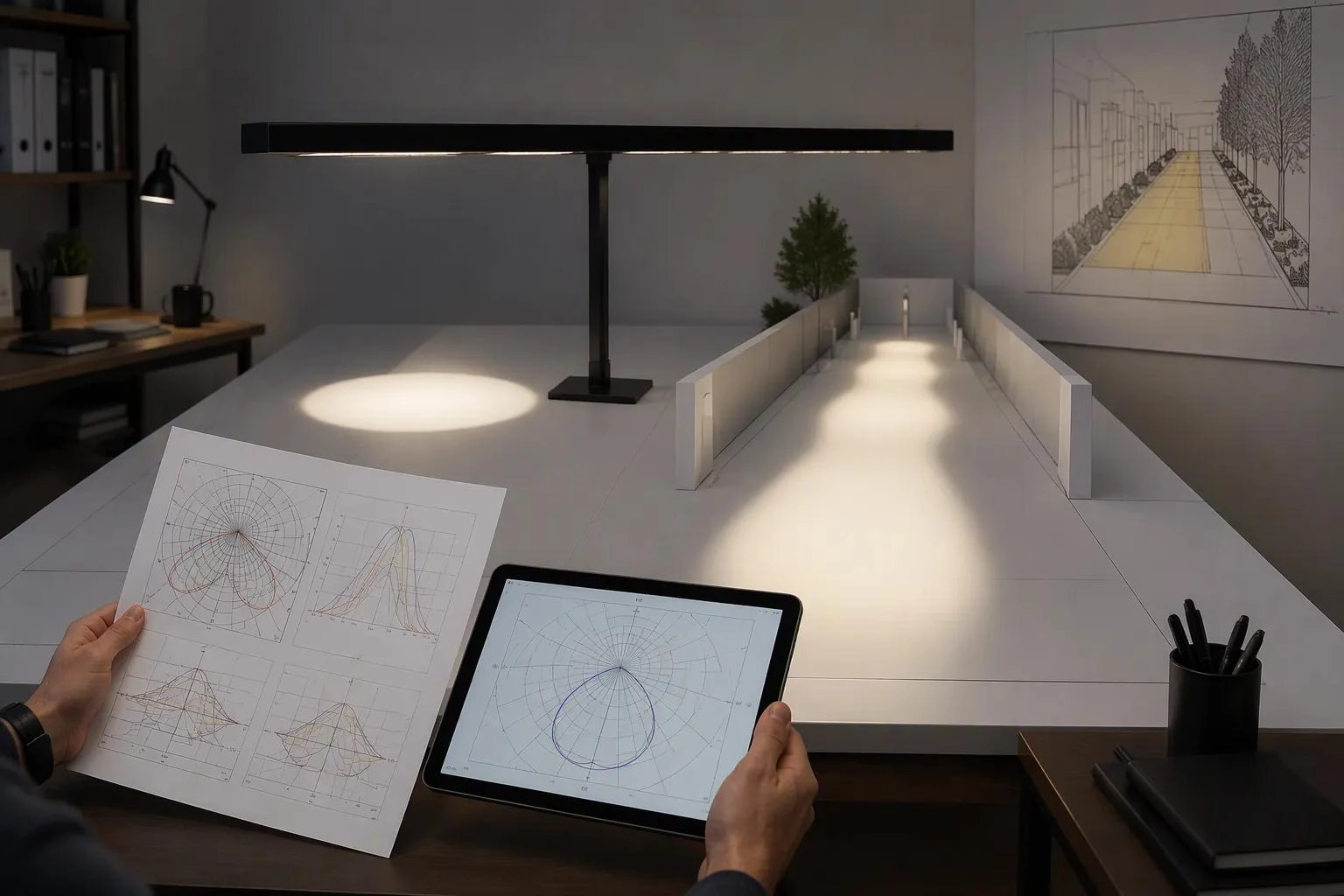
Two questions settle the optic choice. Where must the light land, and what happens to wasted light? A specifier who answers both questions before selecting a fixture avoids the common error of choosing an optic by habit. The guidance below stays practical and application-driven, because no single distribution serves every site.
The target surface defines the beam geometry. Photometric files describe that geometry through C-planes, and each curve on a plot is a vertical slice through the light distribution. The number of planes needed depends on the symmetry type.
Symmetry type | Method used to determine light landing |
Rotationally symmetric (around optical axis) | A single cross-sectional curve fully describes the distribution |
Bilateral symmetry | Two perpendicular characteristic planes (cross-sectional curves) are required |
Asymmetric | Multiple cross-sectional curves must be used to comprehensively depict light output |
A symmetrical fixture needs one or two planes to characterize its output. An asymmetrical distribution, such as a roadway optic, needs multiple planes to reveal how the throw pattern differs in each direction. The specifier reads those curves against the drawing and confirms the light lands on the intended surface. Elliptical lenses stretch the beam into an elongated pattern that follows architectural geometry, such as corridors, pathways, and facades, instead of blasting against it. Rotatable optics let that elongated beam follow the object's geometry. This approach suits architectural linear lighting where the target runs along a defined line.
The second question covers stray output. A specifier can limit spill through a sequence of practical steps.
1. Map the target zone and note boundaries so spill stays outside them.
2. Choose the right fixture type and beam angle, and check the Backlight and Uplight components of the BUG rating to limit trespass and sky glow.
3. Match lumen output to the task to avoid excess that causes spill.
4. Mount and aim carefully, because even small tilt adjustments reduce spill.
5. Add controls such as timers, photocells, and motion sensors so unused fixtures produce zero spill.
6. Inspect regularly to catch drift.
Optic choice supports these steps. Narrower beam angles reduce scatter, and Type II/III distributions keep output within lot boundaries. Cutoff and full-cutoff housings with low BUG ratings direct light downward. Visors, hoods, and shields can retrofit directional control. Precise optical design through simulation directs light only to required areas, which reduces spill and improves efficiency. Improper fixture selection and over-illumination stand as common causes of energy waste that optical planning addresses. A symmetrical beam still fits open floors, and an asymmetrical beam fits a defined target. The specifier who asks both questions reaches the right distribution for the site, and that discipline serves every lighting project well.
The decision framework is simple. Match the optic to the target surface first, then check what happens to stray light. Asymmetric optics suit task-focused work, where control matters. Symmetrical optics fit open areas that need even coverage. Both play legitimate roles in symmetrical vs. asymmetrical lighting, and the application decides the fit.
A specifier who asks where light must land, and what happens to output that misses, reaches the right distribution with confidence. Wasted output can cause glare, trespass, or an underlit surface elsewhere. No single fixture serves every site.
Project teams can request a site-specific layout review to confirm the choice.
Please provide the following detailed information so that our business representatives can better understand your needs and get in touch with you as soon as possible.