
 EN
EN
 English
 繁体中文
繁体中文 Italian
 Greek
Greek Spanish
 Hebrew
 Japanese
 Portuguese
 Korean
 Russian
 French
 German
 Arabic
Blog & Events
Follow NOVANEON for more valuable information to know early
Follow NOVANEON for more valuable information to know early
Aug 28Source: Views: 159
A 50m continuous run led flex delivers uniform brightness through advanced constant current technology with 24V or 48V operation. These systems actively prevent voltage drop across extended distances. Standard led strip products fail this test. Their brightness fades noticeably, and color shifts toward the far end of a long run. That degradation forces installers into complex parallel wiring and multiple drivers.
This article examines the technical mechanisms behind long-run performance. It also explores commercial advantages for large-scale lighting projects. Readers will discover how higher voltage operation reduces material costs. They will also learn how thicker copper PCBs manage heat effectively. The result: simpler installation, fewer components, and significant labor savings. These factors transform the economics of any ambitious project.
Copper conductor resistance creates the fundamental obstacle for long continuous runs in led flexible strip lighting. As current travels through the copper traces, the inherent electrical resistance converts some energy into heat. This process causes voltage to decrease progressively along the strip's length. The far end receives less power than intended, which directly produces reduced brightness and uneven illumination. The severity of this effect intensifies with longer distances, higher current draw, and lower copper quality—such as thinner PCB copper weight or undersized wire gauge.
Real-world measurements demonstrate this problem clearly. In a 24V led strip system, the power supply outputs 24.0V, but the far end measures only 22.4V. That represents a total voltage drop of 1.6V across a single run. The comparison between 12V and 24V systems reveals even starker differences:
Strip Type (5m) | Start Voltage | End Voltage | Voltage Drop | Drop % |
24V 2835 120LED 9.6W | 23.39V | 22.12V | 1.27V | 5.4% |
12V 2835 120LED 9.6W | 11.82V | 10.03V | 1.79V | 15.1% |
The 12V system loses a significantly higher percentage of voltage compared to its 24V counterpart. This degradation manifests in several visible ways: dimmer LEDs near the strip's end, color shifting in RGB products where red dominates as blue and green fade, uneven brightness in white led strip lighting, and flickering under load. These symptoms make standard products unsuitable for professional installation where consistent illumination matters.
The industry has responded to these physical limitations with a practical guideline known as the "5-meter linking rule." Standard 12V and 24V strips cannot exceed specific lengths per power injection point. The maximum run length for 12V systems is 5 meters, while 24V systems extend to 7-10 meters depending on the product specification. Beyond these distances, the voltage drop becomes visually unacceptable.
This constraint forces designers to implement complex parallel wiring schemes. Each 5-meter segment requires its own driver or power injection point. A 50-meter project might demand ten separate drivers, dozens of connection points, and careful planning to ensure each segment receives adequate power. The labor costs multiply quickly, and each connection point introduces a potential failure location. This complexity explains why the 50m continuous run led flex represents such a significant advancement. It eliminates the need for multiple drivers and simplifies the entire led strip length planning process. The flexible strip itself becomes a single, manageable component rather than a patchwork of interconnected segments.
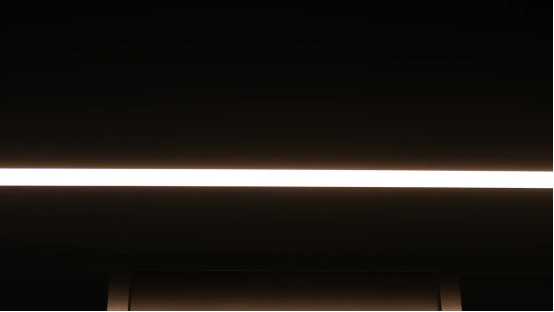
The 50m continuous run led flex overcomes physical limitations through two complementary technologies. Each approach attacks voltage drop from a different angle, and together they enable the longest run possible from a single power feed.
Constant current (CC) and constant voltage (CV) represent fundamentally different driving philosophies. A CV system delivers a fixed voltage and relies on external resistors to limit current. A CC system actively regulates the current flowing through each LED segment, regardless of the voltage available at that point.
The distinction matters enormously for extended installations. Constant current ICs mounted directly on the flexible strip act as local regulators for each series group of LEDs. These ICs actively adjust their operation to maintain the rated current, compensating for any voltage drops along the 50m run. When voltage decreases due to distance, the IC compensates to maintain the rated current, ensuring each LED segment receives consistent power regardless of its position. This neutralizes the dimming effect of voltage drop, keeping brightness identical from the first to the last LED.
Feature | Constant Voltage (CV) | Constant Current (CC) |
Efficiency | Lower (resistors waste power as heat) | Higher (no external resistors needed) |
Cost | Lower upfront cost | Higher upfront cost, but pays off in efficiency |
Lifespan | Shorter (risk of overcurrent) | Longer (stable current reduces wear) |
Scale | Small scale uses (e.g., LED strips) | Large scale uses (e.g., high-power lighting) |
Current Control | Needs external current limiter (resistors) | Built-in regulator |
Brightness | Can cause flickering | Consistent brightness |
Thermal Runaway | Not prevented | Minimized/Prevented |
Based on what we now know about constant current and constant voltage drivers, it is safe to say that constant current will be a better choice for LED lights. Because constant current drivers can provide a consistent level of brightness, constant voltage drivers often cause flickering. This deficiency also greatly reduces the life of LED lighting that uses constant voltage drivers, and LED lighting systems that use constant voltage drivers are generally less efficient. Although constant current drivers are generally more expensive than constant voltage drivers, the efficiency of constant current drivers more than makes up for the extra cost.
The practical implications for installation are substantial. A single-end power supply on constant current strips produces no voltage drop, keeping uniform brightness across the entire 50m length. The design supports wiring up to 50m with 10m, 20m, 30m, 40m, and 50m options available. This eliminates the need for multiple drivers and complex parallel wiring that standard led strip products require.
Operating at 24V or 48V provides a second layer of protection against voltage drop. Higher voltage systems draw less current for the same power output. Since resistive losses in copper conductors scale with the square of current, reducing current dramatically reduces energy lost to heat along the strip.
This relationship enables manufacturers to use thinner conductors while still delivering adequate power. Thinner copper reduces material costs without sacrificing performance. The result is a continuous strip that achieves the maximum run length without additional drivers or power injection points.
For a 50m continuous run led flex, the combination of constant current regulation and higher voltage operation proves decisive. The CC ICs handle local regulation, while the higher voltage minimizes the initial voltage drop that would otherwise overwhelm the system. Together, these technologies allow designers to plan led strip length without the traditional constraints. The flexible strip becomes a single component spanning the entire project, reducing installation complexity and eliminating the failure points that plague segmented systems.
The PCB determines the maximum run length of any LED strip. A 50m continuous run led flex requires copper foil of 6oz or thicker. Standard strips often use thinner copper, which creates excessive resistance over long distances. Thicker copper directly reduces the electrical resistance per unit length of the PCB traces. Lower resistance means less voltage drop along the run, ensuring lights at the far end receive adequate power. The following table outlines the critical PCB features that enable consistent lighting performance at this scale.
PCB Design Feature | Specification / Requirement | Function for Uniform Brightness |
Copper foil thickness | 6oz or thicker (for 50m runs) | Reduces line resistance, minimizing voltage drop |
Circuit architecture | Double parallel high-conductivity circuit | Provides redundant current paths, lowering resistance |
Operating voltage | DC24V or DC48V | Higher voltage reduces current, decreasing I²R losses |
Current regulation | Integrated constant current IC | Maintains steady current to lights |
Power density | ≤12W/m (moderate) | Prevents excessive current draw |
These features directly contribute to achieving the maximum run length possible. Heat management becomes equally critical. Heat causes faster degradation, reduced brightness, and color shift. A 50m installation generates substantial thermal load. Quality PCBs with 2-4 oz double-layer pure copper allow smooth current flow and minimize heat generation. These materials also promote rapid dissipation. Mounting the flexible strip on aluminum profiles provides essential heat sinking. This key practice prevents heat buildup along the entire length. Proper ventilation and integrated heat sinks are essential for a long run. Matching voltage correctly prevents overpowering the lights. Choosing low-wattage options or dimming to 70-80% reduces thermal stress. These steps extend lifespan and maintain brightness stability.
Built-in IC chips keep brightness uniform across the full 50m. Constant current drivers integrated into the flex actively regulate current to each LED segment. These chips compensate for any voltage drop that remains after the PCB design minimizes it. The maximum run length depends on the quality of these chips. The result is consistent brightness from the first light to the last.
Signal integrity requires additional engineering. Dual power injection halves the effective trace length for current flow. Short power loops minimize parasitic inductance. Local decoupling capacitors act as energy reservoirs near each light. They smooth out voltage fluctuations and preserve consistent brightness. These features are essential for achieving the longest run.
Addressable strips rely on specific chips for data transmission. Some chips offer breakpoint resume with dual-signal flow. If one pixel fails, the spare data line allows the signal to skip the broken pixel. This prevents total data loss. Other chips use SPI protocol for serial data transmission. They provide fast updates and reliable data flow. The chip selection determines data speed, color depth, and update rate. These factors ensure uniform brightness across the entire led strip length.
Minimizing trace length reduces inductance and electromagnetic interference. Isolating sensitive signal traces from power traces prevents noise coupling. Routing high-current traces on outer layers ensures effective copper utilization. Adding solder to exposed copper increases cross-sectional area. Keeping current loops small reduces parasitic capacitance. The maximum length of the entire run depends on these design practices. They preserve signal integrity over long distances. Good lighting installation requires careful planning of these features.
Architectural lighting demands flawless uniformity. Any brightness variation in a cove, corridor, or facade becomes immediately visible and professionally unacceptable. A 50m continuous run led flex delivers this consistency through constant current technology and thickened copper foil. The system requires only single-end power for 20m, 30m, or 50m runs, eliminating mid-point injection entirely.
Feature | Specification / Performance |
Voltage drop | Uniform brightness, no visible voltage drop effect |
Color consistency | Consistent color temperature across full length |
LED density | High-density |
Brightness uniformity | Uniform emission, no visible hotspots or dark gaps |
Drive technology | Constant current, dual parallel circuit, thickened copper foil |
Flexibility | Bendable, concealable, adaptable to coves, edges, and columns |
Environmental rating | Weatherproof outdoor grade |
Energy efficiency | 24V/48V high-voltage solution for large-scale projects |
This flexible strip maintains color temperature deviation under 100K across the full length. Designers achieve seamless light output without visible hotspots or dark gaps. The maximum run length of 50 meters means one continuous component spans an entire perimeter ceiling. This approach eliminates the patchwork of segments that standard products require.
Retail environments rely on led tape light to showcase products with consistent, attractive illumination. COB LED strips provide seamless, dot-free illumination with a smooth, continuous glow. These strips operate at lower temperatures, reducing stress on the LEDs and extending lifespan. Retail displays and product shelving benefit from even illumination over large areas without dark spots.
Outdoor signage demands durability alongside uniformity. Weatherproof rating ensures dust tightness and withstands temporary immersion. UV-resistant materials and weatherproof coatings protect against harsh sunlight degradation. Weatherproof connectors maintain safety and reliability under diverse conditions.
The commercial lighting sector gains substantial advantages from this technology. Energy savings are significant compared to traditional lighting. The lifespan is long, translating to many years of continuous use. Payback periods are short. Reduced wiring complexity speeds up project completion. Lower labor costs minimize disruption to commercial operations. Reduced maintenance proves especially valuable in hard-to-reach areas.
This lighting solution transforms large-scale installations. The led strip length planning process simplifies dramatically. One continuous component replaces multiple interconnected segments. The installation requires fewer components and fewer potential failure points. For any ambitious project, the 50m continuous run led flex delivers consistent aesthetics with reduced complexity and lower total cost of ownership.
The 50m continuous run led flex achieves uniform brightness through constant current regulation, higher voltage operation, and robust PCB construction. These technologies work together to eliminate voltage drop across extended distances. Commercial projects benefit from simplified installation without parallel wiring, reduced maintenance costs, and consistent aesthetics throughout the entire led strip length.
Designers should evaluate their specific requirements before selecting a solution. The maximum run length depends on product specifications, environmental conditions, and power delivery choices. Consulting with a lighting specialist or reviewing detailed product datasheets ensures proper selection for any large-scale project. These resources provide critical information about voltage requirements, copper thickness, and IC chip quality. Making an informed decision prevents costly errors and delivers reliable performance across the complete installation.
A single-end power supply supports the full 50-meter run without mid-point injection. The constant current design maintains uniform brightness across the entire length. Installers connect one driver at the start and run the strip continuously. This eliminates the traditional 5-meter linking constraint entirely.
Aluminum profiles provide essential heat sinking for extended runs. The thickened copper PCB minimizes heat generation at the source. Proper ventilation around the profile prevents thermal buildup. Matching voltage correctly and dimming to 70-80% reduces stress further. These practices extend lifespan and maintain brightness stability.
The 50m continuous run eliminates multiple drivers and parallel wiring. A standard 50-meter installation might require ten separate drivers. This system needs only one. Labor costs drop substantially with fewer connection points. Fewer components also mean fewer potential failure locations. The simplified design reduces total installation time significantly.
Yes. Weatherproof versions withstand dust and temporary immersion. UV-resistant materials protect against sunlight degradation. Weatherproof connectors maintain reliability in harsh conditions. The constant current technology ensures consistent performance regardless of environmental temperature fluctuations. This makes the strip suitable for facade lighting and outdoor signage applications.
48V systems draw less current than 24V alternatives for the same power output. Lower current reduces resistive losses along the conductor. This allows thinner copper traces while maintaining performance. The choice depends on specific product specifications and installation requirements. Consulting a lighting specialist helps determine the optimal configuration.
Please provide the following detailed information so that our business representatives can better understand your needs and get in touch with you as soon as possible.